The Unseen Force: How Sonic Toothbrushes Use Fluid Dynamics to Clean Where Bristles Can't
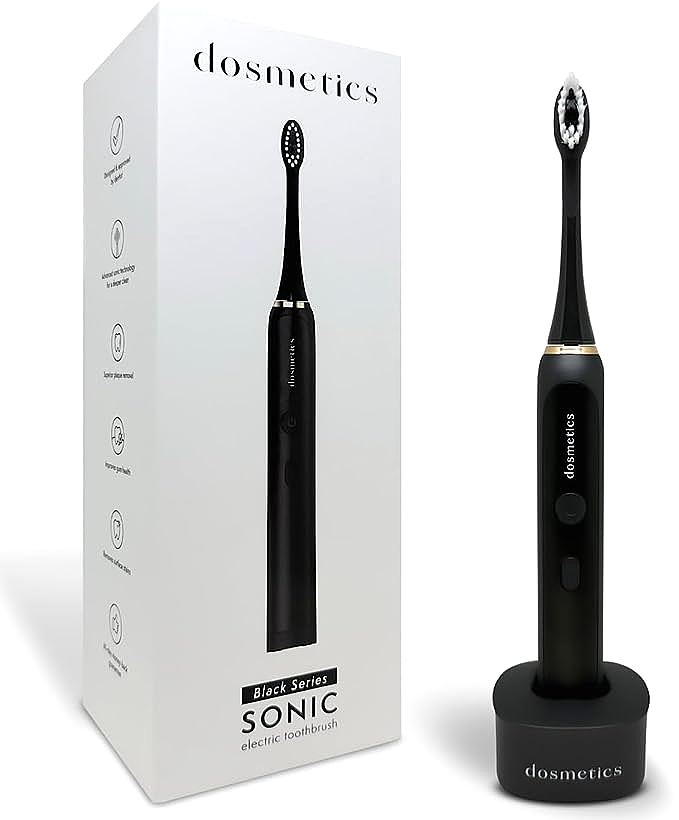
dosmetics DBS0523 Electric Toothbrush
You finish your morning routine, run your tongue across your teeth, and a sense of dissatisfaction sinks in. Despite two minutes of diligent, foaming effort, you can still feel it: a subtle, fuzzy texture clinging to the edges of your molars and the hidden valleys between your teeth. It’s the tenacious film of plaque, a daily reminder that your mouth feels clean, but isn’t truly clean. For decades, the proposed solution has been a variation on a theme: brush harder, brush longer, use a better angle. But what if the answer isn't about more force, but about a smarter force? What if the key to a profoundly clean mouth lies not in friction, but in physics?
The truth is, the most advanced electric toothbrushes have moved beyond the simple mechanics of scrubbing. They operate in a realm of high-frequency vibrations and fluid dynamics, creating a cleaning action so effective it works even where the bristles never touch. This isn't a marketing gimmick; it's a scientific principle, and understanding it will fundamentally change how you think about brushing your teeth. It’s the invisible force that separates a surface-level polish from a deep, inter-dental clean.
The Physics You Can’t See: Fluid Dynamics in Oral Hygiene
To grasp this leap in technology, we must first distinguish "sonic" from merely "electric." A basic electric toothbrush mechanizes the act of scrubbing, oscillating or rotating to replicate manual brushing at a higher speed. A sonic toothbrush does something far more sophisticated. It vibrates. Not just fast, but at a frequency so high—tens of thousands of times per minute—that it fundamentally changes the environment around it. This creates a powerful phenomenon known as Dynamic Fluid Activity. The best analogy lies outside your bathroom: imagine an ultrasonic jewelry cleaner. It submerges a tarnished ring in liquid and, without any brushes, restores its brilliance. It does this by using high-frequency sound waves to create and collapse microscopic vacuum bubbles in the fluid, releasing tiny, powerful shockwaves that blast grime from every crevice. A sonic toothbrush weaponizes this same principle, turning the mixture of saliva and toothpaste in your mouth into an active, energized cleaning solution.
This energized fluid launches a two-pronged attack. The first is the one we all know: the bristles make direct, physical contact with the tooth surface, mechanically scouring away plaque and stains. The second, and more profound, is the non-contact cleaning effect. The high-frequency vibrations radiate energy through the fluid, generating powerful pressure waves and micro-currents that travel far beyond the tips of the bristles. This turbulent flow of energized liquid streams into the tight spaces between teeth and penetrates the critical area just below the gumline. Here, it confronts its primary target: dental plaque. Plaque is not merely food debris; as described in journals like Nature Reviews Microbiology, it is a biofilm—a stubborn, organized colony of bacteria encased in a protective slime. This biofilm is notoriously difficult to disrupt with simple mechanical force. The fluid dynamics generated by a sonic toothbrush, however, create hydrodynamic shear forces that effectively blast apart this protective matrix, flushing away bacteria from the very sanctuaries where they thrive.
Anatomy of a Sonic Engine: Deconstructing the dosmetics DBS0523
This microscopic, high-energy cleaning storm sounds impressive in a lab, but how is this powerful physics principle actually harnessed and controlled in a device you hold in your hand every morning? To understand this, let's place a modern sonic toothbrush, like the dentist-designed dosmetics DBS0523, under the microscope. By examining its core components, we can see how engineering translates physics into clinical effectiveness.
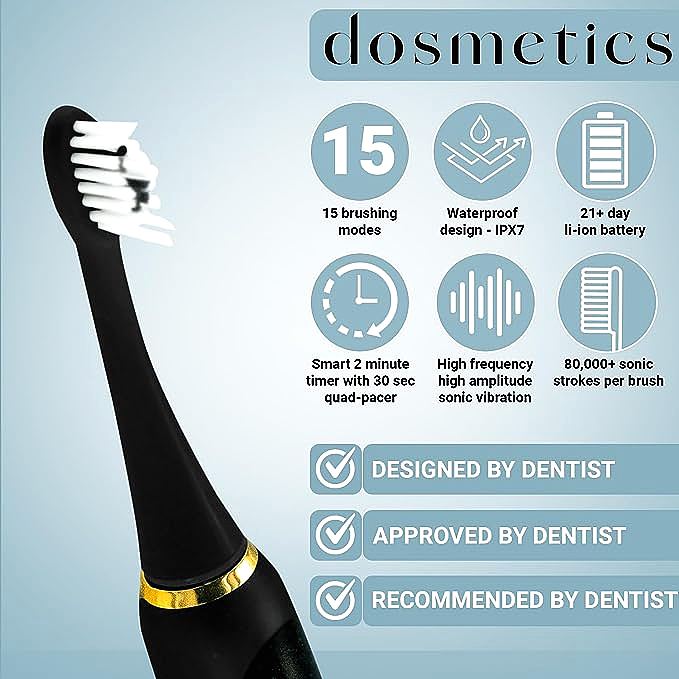
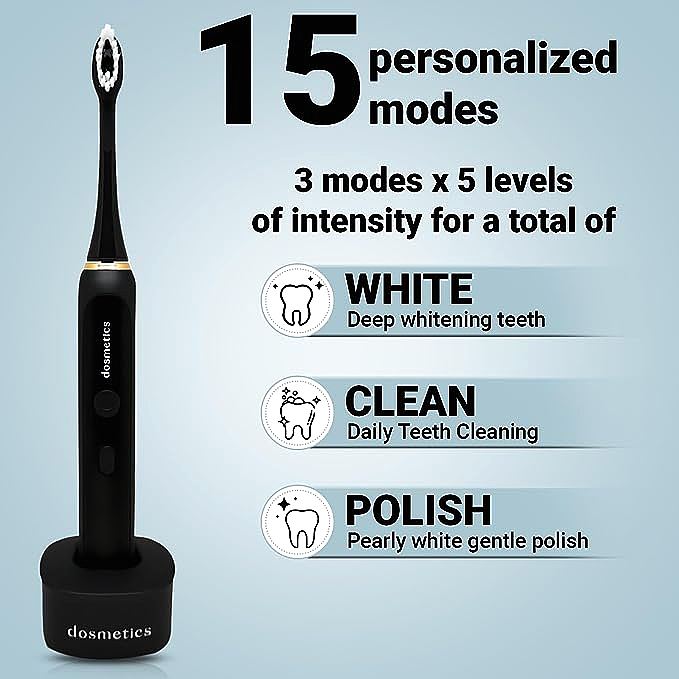
The heart of any sonic device is its motor, and its performance is measured in Vibrations Per Minute (VPM). The DBS0523, for instance, operates at over 40,000 VPM. This isn't an arbitrary number chosen for marketing impact; it is an engineering benchmark. This velocity is required to impart sufficient kinetic energy into the surrounding fluid to initiate vigorous dynamic activity. Below a certain threshold, the vibrations would merely stir the fluid; at this level, they energize it, creating the powerful cleaning currents that define sonic technology. The engineering challenge, however, is not just about raw power. The system must be able to apply this energy with precision. This is addressed through its 15 distinct brushing modes. These modes are not superfluous features; they are carefully calibrated protocols. A "Clean" mode might maintain a consistent high frequency for optimal plaque disruption, while a "White" mode could introduce a varied frequency to dislodge surface stains, and a "Polish" mode might use rapid, shorter-amplitude vibrations to buff the enamel. The five intensity levels for each mode give the user granular control over the amplitude, allowing them to tailor the force to their specific needs—be it sensitive gums requiring a gentler application or stubborn stains demanding more power—without sacrificing the underlying fluid dynamic principle.
Yet, even the most advanced engine is ineffective if operated incorrectly. The American Dental Association (ADA) and dental professionals worldwide stress the importance of brushing for a full two minutes. To this end, the inclusion of a 2-minute quadrant timer is perhaps the most critical feature for clinical success. This integrated pacer, which provides a brief pause every 30 seconds, is a guidance system that enforces correct methodology. It ensures that the science is applied consistently across all four quadrants of the mouth for the dentist-recommended duration, preventing the common human error of focusing on the front teeth while neglecting the hard-to-reach molars where biofilm often accumulates.
Built for the Real World: Engineering Beyond the Engine
While the engine's power is paramount, a truly effective instrument is more than just its motor. It must be robust enough to survive its operating environment and intuitive enough to be used correctly. This is where thoughtful, practical engineering comes into play. The bathroom is a hostile environment for electronics, defined by water and humidity. For this reason, a feature like an IPX7 waterproof rating is not a luxury but a necessity. According to the International Electrotechnical Commission's standard, this rating guarantees that the device can withstand submersion in up to one meter of water for 30 minutes. For the user, this translates into peace of mind, ensuring that accidental drops into a wet sink or consistent exposure to splashes won't compromise the device's integrity or safety.
This thoughtful engineering extends to the balance between power and longevity. A 40,000 VPM motor is energy-intensive, yet a device that requires constant charging becomes a nuisance. The 21-day battery life of the DBS0523 represents a significant engineering trade-off, optimizing the power-management system to deliver high performance without sacrificing user convenience. It's a testament to the fact that great design considers the entire user experience, from the microscopic action on the tooth surface to the macroscopic reality of daily life.
Conclusion: From User to Informed Operator
The evolution from a simple manual brush to a high-frequency sonic instrument marks a paradigm shift in our approach to oral health. The true innovation lies not in a more aggressive friction, but in the elegant application of fluid physics to achieve a level of clean that was previously impossible at home. Its value is not measured merely in features, but in its capacity to generate an unseen, powerful force that disrupts disease-causing biofilm in the most inaccessible areas of your mouth.
By understanding the science—the dynamic fluid activity, the engineering behind VPM and multi-modal systems, and the clinical necessity of guided timers—you are no longer just a consumer choosing a product. You become an informed operator of a sophisticated scientific instrument. This knowledge empowers you to look past marketing claims and evaluate any sonic toothbrush on its ability to effectively deliver on the promise of its underlying physics. It transforms the act of brushing from a mundane chore into a targeted, technology-assisted health procedure, giving you the power to achieve a truly profound state of clean.
dosmetics DBS0523 Electric Toothbrush
Related Essays

The Unseen Force: How Sonic Toothbrush Technology Redefines a Deeper Clean

The Unseen Force: How Sonic Toothbrush Technology Redefines a Deeper Clean
The Unseen Force: How Sonic Toothbrushes Like the FUMEIKANG FS13 Revolutionize Your Oral Health
The Science of a Deeper Clean: An In-Depth Look at the Burst Sonic Toothbrush
The Unseen Force: How Sonic Toothbrushes Wage a Microscopic War on Plaque
The Physics of a Flawless Clean: How 40,000 VPM Sonic Toothbrushes Actually Work
The Unseen Force in Your Toothbrush: Deconstructing the Science of Sonic Cleaning
The Physics of a Flawless Smile: How 40,000 VPM Sonic Toothbrushes Really Work

Big Mouth Electric Toothbrush Rotimi Royalty Edition: Elevate Your Oral Care with Smart Technology
