The Invisible Tether: Decoded Wireless Efficiency and the Psychoacoustics of Compression
Update on Jan. 13, 2026, 8:58 a.m.
In the grand tapestry of technological evolution, few achievements are as paradoxically complex and effortless as wireless audio. We take for granted the ability to pluck a pair of earbuds from a case and instantly hear music streaming from a device specifically paired to them, amidst a sea of invisible radio frequency interference. Yet, this seamless experience is the result of a decades-long struggle against the fundamental limitations of physics and information theory.
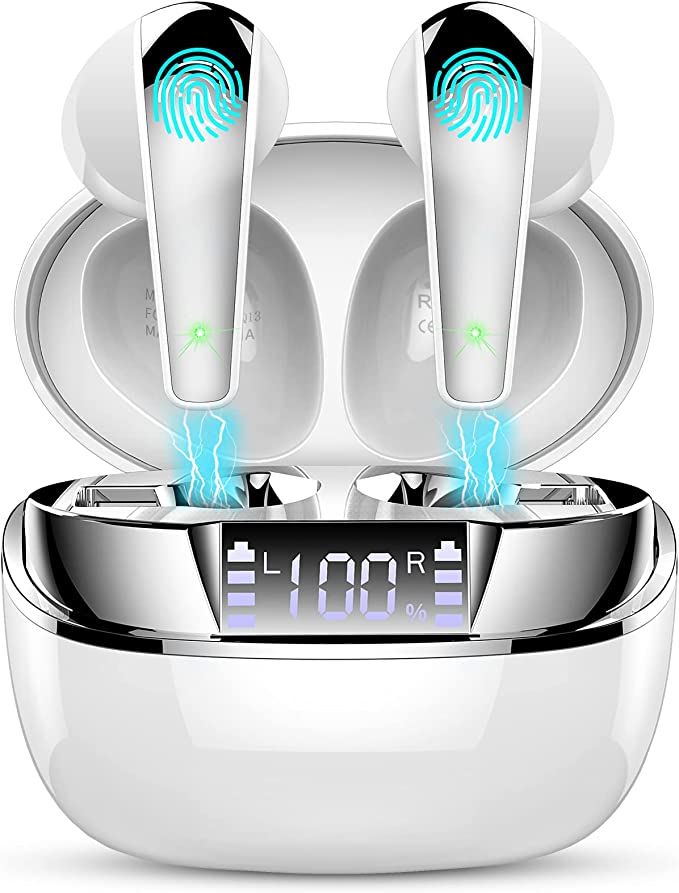
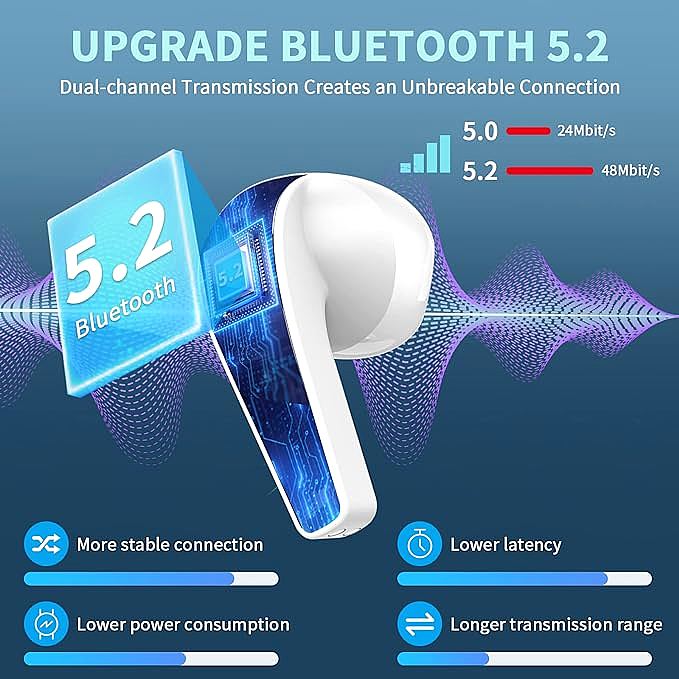
The transition from the wired era to the wireless age wasn’t merely about cutting the cord; it was about reimagining how sound is packaged, transmitted, and reconstructed. It required solving a trifecta of competing constraints: bandwidth (how much data can we send?), latency (how fast can we send it?), and power consumption (how long can we keep doing it?). Devices like the Uaue Q13 Wireless Earbuds, with their Bluetooth 5.2 architecture and extended battery autonomy, stand as modern monuments to this engineering victory. But to truly appreciate the music, one must appreciate the invisible highway it travels upon. This article explores the intricate science of wireless protocols, the psychoacoustic magic of audio compression, and the electrochemical balancing act of modern power management.
The Evolution of the Airwaves: From Basic Rate to Bluetooth 5.2
Bluetooth technology, named after a 10th-century Danish king who united dissonant tribes, was designed to unite disparate devices. However, its early iterations were far from capable of handling high-fidelity audio. They were plagued by connection drops, high latency, and an appetite for battery power that rendered them impractical for prolonged listening.
The journey to the Bluetooth 5.2 standard found in the Uaue Q13 is a study in “Frequency Hopping Spread Spectrum” (FHSS). The 2.4 GHz ISM band, where Bluetooth operates, is a crowded, chaotic highway shared by Wi-Fi routers, microwaves, and countless other smart devices. To survive in this hostile environment, Bluetooth devices don’t just broadcast on one frequency; they hop between 79 designated channels 1,600 times per second.
The Mechanics of Stability
In earlier versions, this hopping was somewhat random. If a channel was clogged with Wi-Fi traffic, the audio packet would be lost, resulting in a stutter. Bluetooth 5.2, utilizing advanced Adaptive Frequency Hopping (AFH), is smarter. It actively scans the spectrum, creates a “map” of congested channels, and avoids them entirely. It’s like a driver who knows exactly which lanes are closed for construction miles ahead and changes routes proactively.
Furthermore, Bluetooth 5.2 introduces enhanced attributes for LE (Low Energy) Audio. While the “Classic” Bluetooth radio was power-hungry, the LE architecture allows for data transmission in short, efficient bursts. It introduces “Isochronous Channels,” a feature that allows time-bound data (like music) to be synchronized perfectly between the source and multiple receivers (the left and right earbuds). This replaces the older, less efficient method where the phone connected to one earbud, which then relayed the signal to the other. The result is the “rock-solid connection” and “faster transmission speed” that defines the modern user experience.
The Psychoacoustics of Compression: Why “Lossy” Sounds Good
Once the connection highway is established, we face the bandwidth problem. Uncompressed CD-quality audio requires a data rate of about 1,411 kilobits per second (kbps). Bluetooth, realistically, offers a fraction of that for audio streams. Attempting to force raw audio through this wireless pipe would be like trying to push a watermelon through a garden hose. The solution is compression.
The Uaue Q13 specifications highlight AAC (Advanced Audio Codec) compatibility. Understanding AAC requires a detour into the biology of human hearing. AAC is a “perceptual codec.” It doesn’t just indiscriminately chop off data; it exploits the limitations of the human ear and brain, a field known as psychoacoustics.
Auditory Masking: The Magician’s Trick
The core principle behind AAC is “Auditory Masking.” Our ears are not microphones; they don’t capture everything equally.
1. Simultaneous Masking: If a loud sound (like a booming drum) and a quiet sound (like a faint whisper) occur at the same frequency at the same time, the ear physically cannot hear the whisper. The loud sound “masks” the quiet one.
2. Temporal Masking: Immediately after a loud sound stops, there is a brief window (a few milliseconds) where the ear is still recovering and cannot perceive quieter sounds.
AAC algorithms analyze the music in real-time. They identify these masked, inaudible sounds and discard that data. Since the brain wouldn’t have perceived them anyway, their removal is theoretically transparent to the listener. This allows the file size to be reduced significantly without a perceived loss in quality. Compared to the older SBC codec, which uses a simpler sub-band coding approach, AAC retains more detail in the high frequencies and offers a higher resolution listening experience, particularly on Apple devices which are optimized for this format. This is the scientific engine behind the “ultra-accurate HD sound” promised by modern wireless gear.
The Electrochemical Balancing Act: Energy Density vs. Consumption
Perhaps the most critical, yet least understood, aspect of TWS (True Wireless Stereo) earbuds is power management. The form factor is unforgiving. An earbud must house the driver, the magnet, the Bluetooth antenna, the logic board, microphones, and the battery—all within a shell weighing less than 5 grams.
The Uaue Q13 claims 7 hours of playtime on a single charge, with a total of 35 hours via the charging case. Achieving this in such a miniaturized footprint is a testament to the evolution of Lithium-Polymer (Li-Po) battery chemistry and system-on-chip (SoC) efficiency.
The Voltage Curve and System Optimization
Li-Po batteries are favored for their high energy density and ability to be molded into custom shapes (like the curved casing of an earbud). However, a battery is not a bottomless tank; its voltage drops as it discharges. A fully charged Li-Po cell sits at about 4.2V, but as it drains towards 3.0V, its ability to deliver current diminishes.
The “35H LED Power Display” on the case is more than a convenience; it’s a window into the battery management system (BMS). The BMS is a critical circuit that monitors the voltage and temperature of the cells. It prevents overcharging (which can cause fires) and over-discharging (which kills the battery chemistry).
The longevity of the Q13 is less about a “bigger battery” (physics limits the size) and more about the “power budget” of the components.
1. Bluetooth 5.2 Efficiency: The radio is often the biggest power drain. The newer protocol’s ability to “sleep” and “wake” in microseconds between data packets drastically reduces average power consumption.
2. Class-D Amplification: Modern earbuds use Class-D amplifiers, which are switching amplifiers. unlike Class-AB amps used in old hi-fi gear (which waste energy as heat), Class-D amps are over 90% efficient, meaning almost all the battery energy goes into moving the driver and creating sound.
One-Step Pairing: The Protocol Handshake
The user experience of “One-Step Pairing”—where the earbuds connect the moment the lid is opened—conceals a complex digital handshake.
1. Hall Effect Sensor: The charging case likely contains a Hall Effect sensor, a magnetic sensor that detects the position of the lid. Opening the lid disrupts a magnetic field, triggering a wake-up signal to the earbuds’ controllers before they are even removed.
2. Advertising Packets: The earbuds immediately begin broadcasting “advertising packets” on three specific Bluetooth channels.
3. Security Keys: Since the device was previously paired, the phone and earbuds exchange encrypted security keys (stored in non-volatile memory) to verify identity. This happens in milliseconds.
This seamless automation is the result of tight integration between hardware sensors and software protocols, removing the friction that plagued early wireless devices.
Conclusion: The Quiet Complexity
When we look at a device like the Uaue Q13 Wireless Earbuds, it is easy to see just a plastic accessory. But beneath that white-silver exterior lies a convergence of advanced disciplines. It is a radio station broadcasting on hopping frequencies to avoid the microwave oven. It is a psychoacoustic computer tricking the brain into hearing more than is transmitted. It is a chemical power plant carefully managing milliwatts of energy to outlast a trans-atlantic flight.
The “invisible tether” of Bluetooth has grown from a fragile thread into a robust cable, strong enough to carry the weight of our high-fidelity expectations. As we move forward, these technologies will only become more efficient and more transparent, leaving us with nothing but the music, delivered as if by magic, but grounded firmly in science.