The Algorithm of Silence: How 4-Mic ENC Transforms Calls
Update on Jan. 3, 2026, 10:01 a.m.
In the age of remote work and digital nomadism, your earbuds are your office door. When you put them on, you are signaling that you are ready to communicate. But for the person on the other end of the line, the experience can be miserable if your hardware isn’t up to the task.
Background noise—the barista grinding coffee, the wind howling, the subway screeching—is the enemy of clarity.
The Cillso H97 tackles this with 4-Mic ENC (Environmental Noise Cancellation).
Note the distinction: This is not ANC (Active Noise Cancellation) for you; it is ENC for them.
This article explores the algorithmic warfare against noise. We will analyze the geometry of quad-microphone arrays, the signal processing of voice isolation, and why the H97’s LED Display is the unsung hero of the mobile professional.
The Geometry of the Array: 4 Microphones
Why four? Why not one?
A single microphone is an omnidirectional ear. It hears everything equally.
To filter noise, you need Spatial Information.
* The Beamforming Array: The H97 places two microphones on each earbud.
1. Voice Mic: Located at the tip of the stem, pointed at your mouth.
2. Noise Mic: Located on the back or top, pointed at the world.
By measuring the time delay (phase difference) between sound hitting Mic 1 and Mic 2, the DSP (Digital Signal Processor) can triangulate the source of the sound.
* On-Axis: Sound coming from your mouth hits Mic 1 first. Keep it.
* Off-Axis: Sound coming from the side (the coffee grinder) hits Mic 2 first. Kill it.
This creates a virtual “cone of sensitivity” directed at your mouth. Everything outside this cone is aggressively attenuated (by “over 95dB” according to specs). This allows you to have a whispered conversation in a noisy environment without shouting.
The Visual Dashboard: Dual LED Display
For a communication tool, reliability is key. You cannot afford to have your headset die mid-pitch.
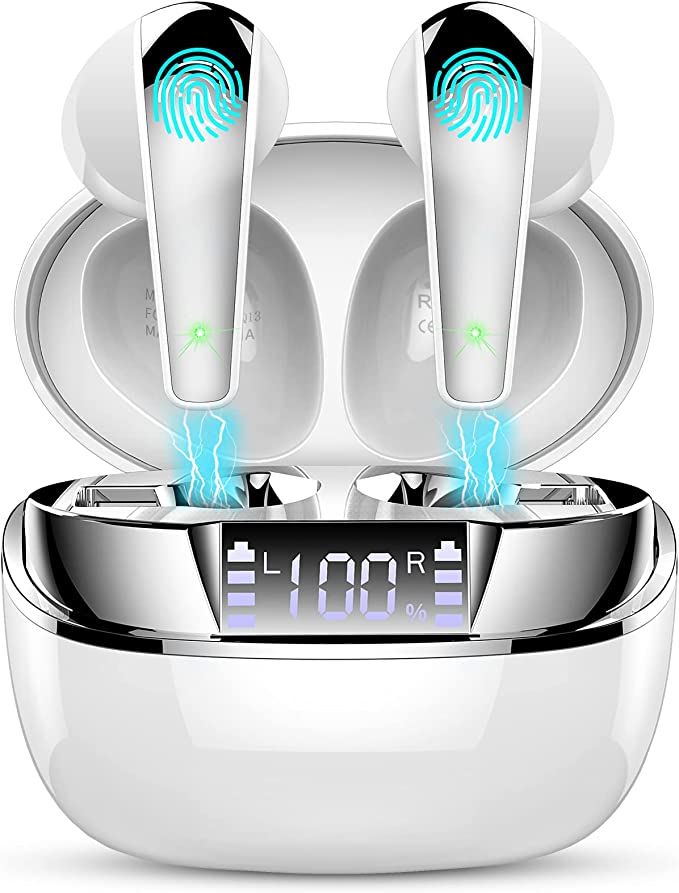
The H97 features a Dual Digital Battery Display.
* The Case: A numeric percentage (0-100%). This provides the granular data needed for planning. “I have 15% left” is actionable information; a blinking red light is just anxiety.
* The Buds: Individual battery bars for Left and Right. This is critical for diagnosing charging issues (e.g., a dirty contact preventing one bud from charging).
For the power user, this display transforms the case into a dashboard. It provides the situational awareness needed to manage the 40-Hour energy budget effectively.

The Human Interface: Smart Touch
Physical buttons on earbuds push the device into your ear canal, causing pain.
The H97 uses Smart Touch Control.
* Capacitive Sensing: It detects the electrical field of your finger.
* The Logic: Tap to answer, long press to reject. This interface is designed to be low-impact. You can control your calls without disrupting the delicate “semi-in-ear” fit.
Conclusion: The Professional’s Companion
The Cillso H97 masquerades as a music device, but its engineering reveals a focus on communication.
By combining a comfortable semi-in-ear fit (which lets you hear your own voice naturally, avoiding the “stuffy” feeling of IEMs) with a sophisticated 4-mic noise reduction system, it creates the perfect environment for conversation.
It is a tool for connection, ensuring that no matter where you are physically, your voice arrives clearly and professionally.