Breathing Space: The Physics of Open-Air In-Ear Monitors
Update on Jan. 3, 2026, 9:14 a.m.
In the specialized world of audiophilia, a dichotomy has long existed between the expansive, airy sound of open-back headphones and the intimate, isolated experience of In-Ear Monitors (IEMs). Traditionally, IEMs are sealed systems. They rely on creating a pressurized vacuum within the ear canal to deliver bass response and block external noise. This isolation, while practical for commuting, often results in a “closed-in” soundstage—the sensation that the music is originating from inside the center of your skull, rather than from the room around you.
The Koss KEB90 Utility Earbuds challenge this convention with a “high-fidelity open-air design.” This engineering choice is significant. It represents an attempt to bridge the gap between the portability of an earbud and the spatial presentation of an open-back over-ear headphone. This article explores the acoustic physics behind this design, examining how airflow, impedance, and driver mechanics interact to create a unique auditory illusion.
The Acoustics of Containment: Closed vs. Open Systems
To understand the KEB90, we must first understand the physics of the ear canal. When you insert a standard sealed IEM, you are essentially creating a closed acoustic coupler. The driver diaphragm pushes air directly against the eardrum.
The Closed-System Advantage and Flaw
In a closed system, the trapped air acts as a spring. This pressure allow for powerful, visceral bass reproduction even with small drivers, as there is nowhere for the low-frequency energy to escape. However, this trapped energy also creates standing waves and resonances within the ear canal. Psychologically, the lack of “cross-feed” (sound from the left ear reaching the right, and vice versa) and the absence of environmental interaction cue the brain to perceive the sound as artificial and internalized. This is often referred to as “in-head localization.”
The Open-Air Breakthrough
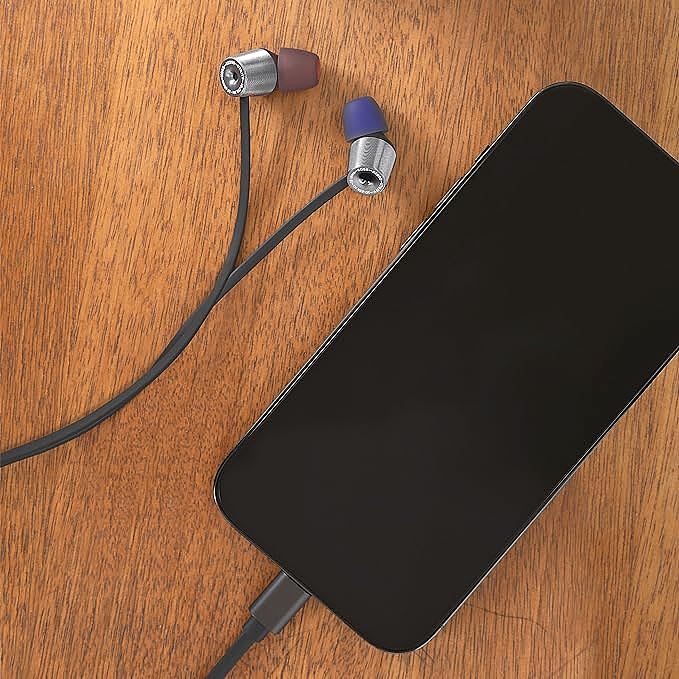
The KEB90’s “open-air design” introduces controlled venting. By incorporating an air inlet (detailed etching around the exterior) into the stealth grey aluminum chassis, Koss allows the backwave of the driver to interact with the outside world.
This venting serves two critical physical functions:
1. Pressure Relief: It equalizes the air pressure between the ear canal and the outside environment. This reduces the “pneumatic hammer” effect on the eardrum, potentially lowering listening fatigue during long sessions.
2. Soundstage Expansion: By allowing air to move more freely behind the driver, the diaphragm encounters less resistance (mechanical damping). This often leads to a faster transient response and a perceived widening of the stereo image. The brain receives subtle acoustic cues that suggest the sound is interacting with an open space, rather than a sealed tube.

The Engine: 16 Ohm Dynamic Driver Mechanics
The heart of the KEB90 is a 16 Ohm dynamic driver. In the world of transducers, the dynamic driver (moving coil) is the workhorse. It operates on the principle of electromagnetism: a voice coil suspended in a magnetic field moves a diaphragm when an electrical current is applied.
Low Impedance and Drivability
The choice of 16 Ohm impedance is strategic for a portable “Utility” device. Impedance is the measure of resistance to the electrical current. A low impedance means the driver requires very little voltage to reach high volumes. * The Physics: $Power = Voltage^2 / Impedance$. As impedance drops, power (and volume) increases for the same voltage. * The Application: This makes the KEB90 extremely “efficient,” with a sensitivity of 98 dB SPL. It allows even the weak amplifiers found in budget smartphones or USB-C dongles to drive the earbuds to full dynamic potential without clipping or distortion. There is no need for a bulky external amplifier to “wake up” these drivers.
Frequency Response and the “Koss Sound”
The KEB90 boasts a frequency response of 10-25,000 Hz. While this exceeds the human hearing range (20-20kHz), the extension at both ends is indicative of driver capability. * Sub-Bass (10Hz): Reproducing frequencies this low in an open-air design is a significant engineering challenge. Usually, open designs lose sub-bass energy as it escapes through the vents. Koss likely employs a specific damping material or “acoustic lens” behind the driver to manage this airflow, ensuring that while the mids and highs breathe, the bass retains its impact—a hallmark of the “Sound of Koss” signature, often described as warm and energetic.
The Seal Variable: Eartip Physics
No discussion of IEM acoustics is complete without addressing the eartip seal. For the KEB90, which already has an open-back vent, the seal in the ear canal becomes the primary variable for tuning.
The product includes silicone and foam cushions. These materials behave differently acoustically: * Silicone: Non-porous and smooth. It reflects high frequencies effectively, preserving the “crisp highs” and detail. It creates a hermetic seal that maximizes bass pressure. * Foam: Porous and expanding. Foam tends to absorb some high-frequency energy, smoothing out “sharp” treble peaks. It also conforms to the ear canal shape, often creating a more consistent seal for bass, but with a slightly “warmer” or “darker” tone.
Because the KEB90 is an open-air design, the choice of eartip is critical to balancing the sound. A poor seal with an open-back IEM will result in a complete collapse of bass response, leaving the sound “tinny” (as noted in some critical reviews). The user is essentially the final acoustic engineer, tuning the device by selecting the correct physical interface.
Psychoacoustics: The Perception of “High Fidelity”
Ultimately, high fidelity is not just about graphs; it is about perception. The KEB90 aims to deliver a “live musical performance” experience. This goal relies on psychoacoustics—how our brain interprets sound.
The combination of the open-air vent (spatial cues), the low-impedance dynamic driver (dynamic punch), and the correct eartip seal (isolation) creates a hybrid experience. It attempts to give the listener the “best of both worlds”: the visceral impact of an IEM with the breathability of an open headphone.
However, this design is not without trade-offs. The open vents mean that noise isolation is inherently compromised compared to a fully sealed unit. External noise can leak in, and music can leak out. This makes the KEB90 less ideal for a noisy subway commute but perfect for a quiet office or a walk in the park where situational awareness is desired. This aligns with the “Utility” moniker—it is a tool designed for specific environments where total sensory deprivation is not the goal.
Conclusion: The Engineering of Balance
The Koss KEB90 Utility Earbuds represent a sophisticated exercise in acoustic balancing. By opting for an open-air architecture in an in-ear form factor, Koss challenges the norms of the market. They rely on the precise interplay of venting, driver efficiency, and eartip sealing to create a sound signature that is expansive yet impactful.
For the listener, understanding these physics unlocks the true potential of the device. It explains why the fit is so critical, why the foam tips sound different from the silicone, and why the soundstage feels wider than typical earbuds. In an era of generic, sealed plastic buds, the KEB90 stands as a testament to the nuance of electro-acoustic engineering.