Materials and Modularity: The Engineering of Longevity in In-Ear Monitors
Update on Jan. 13, 2026, 8:53 a.m.
In the disposable world of consumer electronics, where batteries die and Bluetooth protocols become obsolete, the wired In-Ear Monitor (IEM) stands as a bastion of longevity. Its lifespan is not measured in charging cycles, but in the durability of its materials and the universality of its connections.
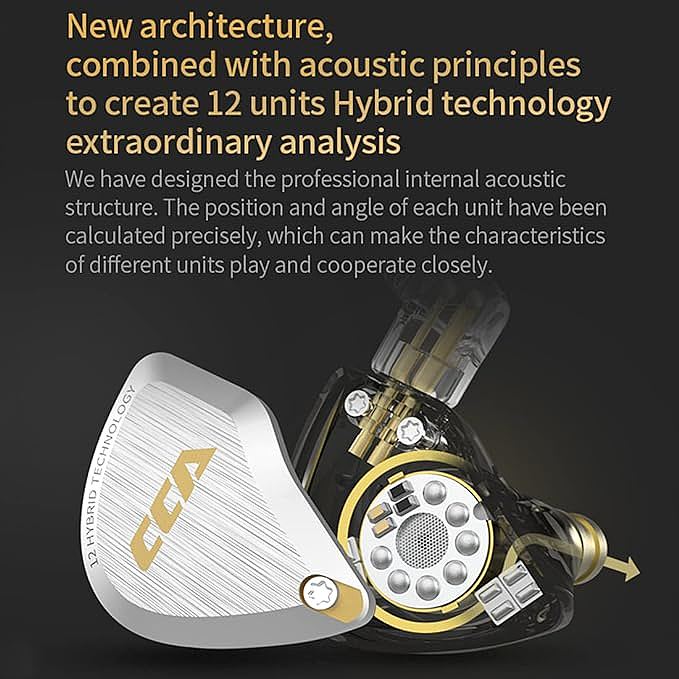
The CCA C12 is not just an audio device; it is a modular system built from Zinc Alloy and Medical-Grade Resin. By adopting the audiophile standard of detachable cables, it separates the fragile component (the wire) from the durable component (the earpiece). This article explores the acoustic properties of metal housings, the ergonomics of resin molding, and the economic and ecological value of modular design.
The Acoustics of Heavy Metal: Zinc Alloy Faceplates
The first thing one notices about the C12 is its weight. The faceplate is cast from Zinc Alloy. In audio engineering, mass is not always the enemy; sometimes, it is the anchor.
Resonance Control
Every object has a resonant frequency—a pitch at which it naturally vibrates. If a speaker housing vibrates along with the driver, it introduces “coloration” or distortion to the sound. Ideally, a speaker cabinet should be acoustically inert.
* Density: Zinc alloy is dense. This high mass makes it difficult for the sound waves generated by the drivers to “shake” the housing.
* Damping: The combination of a metal faceplate bonded to a resin shell creates a constrained layer damping effect. Vibrations traveling through the resin hit the dense metal and are reflected or dissipated as heat.
This results in a cleaner sound, particularly in the lower frequencies, where high-energy waves are most likely to cause cabinet resonance. The “solid” feel of the C12 translates directly to a “solid” sound presentation.
The Biomechanics of Resin: Custom-Like Fit
The body of the C12 is made from Imported Resin. This material choice is borrowed from the world of custom IEMs (CIEMs), where molds are taken of a musician’s ear. * Thermal Properties: Unlike metal, which feels cold, resin warms quickly to body temperature, making it comfortable for long listening sessions. * Ergonomic Shaping: The C12’s shell is molded based on the average data of thousands of human ear impressions. The “fin” locks into the concha cymba, while the nozzle angles into the ear canal. This Mechanical Interlocking distributes the weight of the zinc faceplate, ensuring the earpiece stays secure even during stage performances or workouts. * Skin-Friendliness: High-quality resin is hypoallergenic and non-porous, resisting the corrosive effects of sweat and skin oils that degrade rubberized plastics over time.
The Modular Interface: 0.75mm 2-Pin Connector
The Achilles’ heel of any headphone is the cable. It is flexed, pulled, and twisted thousands of times. When a fixed cable breaks, the headphones are trash.
The CCA C12 features a Detachable 0.75mm 2-Pin Interface. This transforms the cable from a permanent limb into a replaceable consumable.
The Upgrade Path
This modularity opens up a world of customization (cable rolling):
1. Durability: If the cat chews the wire, you replace the wire for $10, not the earphones for $50.
2. Functionality: Users can swap the stock cable for one with a microphone for calls, or a high-purity silver cable for aesthetic and theoretical sonic improvements.
3. Wireless Conversion: Perhaps the most powerful upgrade is the ability to attach Bluetooth Modules. By plugging in a Bluetooth ear hook (sold separately), the C12 transforms from a wired monitor into a True Wireless Stereo (TWS) headset. This adaptability ensures the drivers remain useful even as the user’s needs change between critical wired listening and convenient wireless use.

Conclusion: Built to Outlast
The CCA C12 represents a philosophy of Sustainable Engineering. By utilizing dense Zinc Alloy for acoustic inertia, ergonomic Resin for biological compatibility, and a modular 2-Pin connection for repairability, it rejects the paradigm of planned obsolescence.
It is a tool designed to adapt. Whether connected to a high-end DAC for critical listening or a Bluetooth module for a gym session, the core component—the sophisticated 12-driver acoustic engine—remains the constant heart of the experience.