The Anatomy of Detail: Dissecting the Hybrid Driver System of the CCA C12
Update on Jan. 13, 2026, 8:48 a.m.
For decades, the standard consumer earbud relied on a single component: the full-range dynamic driver. Like a lone musician trying to play every instrument in an orchestra simultaneously, a single driver faces inherent physical compromises. It must be heavy enough to push bass yet light enough to flutter with treble. Often, this results in “muddy” sound where details are lost in the struggle for frequency coverage.
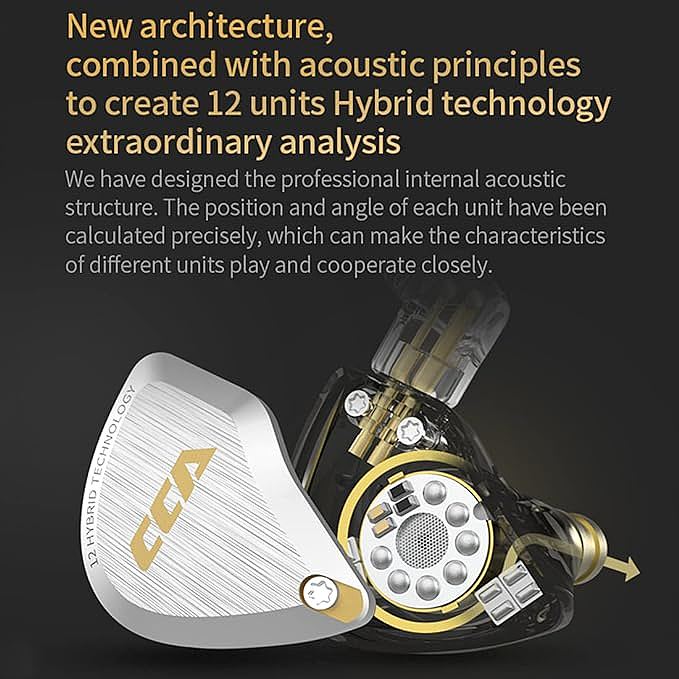
The CCA C12 In-Ear Monitor (IEM) represents a democratization of a technology once reserved for professional stage gear: the Hybrid Driver System. By packing six drivers into each earpiece (12 total in a pair), it assigns specific parts of the frequency spectrum to specialized components. This article peels back the resin shell to explore the physics of this acoustic ensemble, explaining why mixing “Dynamic” and “Balanced Armature” drivers is the engineering key to high-fidelity sound.
The Physics of Specialization: Why More Drivers?
The fundamental challenge in audio reproduction is Inertia. * Bass: To create low frequencies (20Hz - 200Hz), a driver must move a large volume of air. This requires a large surface area and significant excursion (movement). A heavy, rigid cone is ideal. * Treble: To create high frequencies (2kHz - 20kHz+), a driver must vibrate thousands of times per second. This requires near-zero mass to start and stop instantly (transient response).
A single driver cannot be both heavy and light. The solution is Specialization. The CCA C12 uses a 10mm Dynamic Driver for the lows and five Balanced Armatures for the mids and highs.
The 10mm Dynamic Driver: The Air Mover
The “1DD” in the 1DD+5BA configuration refers to the 10mm Double Magnetic Dynamic Driver. * Mechanism: A coil of wire sits in a magnetic field attached to a diaphragm. Current moves the coil, which moves the diaphragm. * The “Double Magnetic” Advantage: By using a dual-magnetic circuit, the magnetic flux density is increased. This provides stronger control over the voice coil, allowing for tighter, punchier bass response compared to standard dynamic drivers. It moves the air required for the visceral “thump” of a kick drum.
The Balanced Armature Quintet: The Precision Instruments
The “5BA” refers to five Balanced Armature drivers.
* Mechanism: Unlike a dynamic driver, a BA does not use a moving coil. Instead, a tiny reed (armature) is balanced between two magnets. A signal vibrates the reed, which drives a microscopic diaphragm via a drive rod.
* The Physics of Speed: The moving mass of a BA is infinitesimal. It has almost no inertia. This allows it to track high-frequency transients—the snap of a snare, the breath of a vocalist—with surgical precision.
* The Array: The C12 uses specific BA models:
* 2x 30095 High-Frequency BAs: Dedicated to the upper treble and “air” frequencies.
* 2x 50060 Mid-Frequency BAs: Dedicated to vocals and instruments like guitars.
* 1x Combined Mid/High BA: Smoothing the transition.
This array ensures that no single driver is stressed. Each operates in its optimal frequency range, resulting in lower distortion and higher resolution.
The Electronic Conductor: Crossover Networks
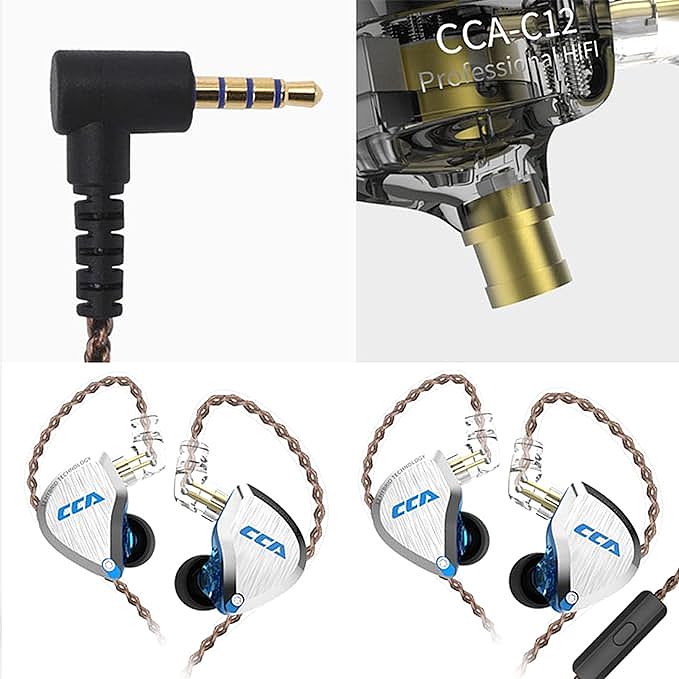
Having six drivers is useless if they all play the same thing; it would be chaos. The “Brain” of the C12 is the Electronic Crossover Board.
A crossover is a circuit of capacitors and inductors that filters the audio signal.
1. Low-Pass Filter: Sends only bass frequencies to the Dynamic Driver.
2. Band-Pass Filter: Sends only mid-range frequencies to the mid-BAs.
3. High-Pass Filter: Sends only treble frequencies to the high-BAs.
The engineering challenge is Phase Coherence. At the “crossover point” (where the bass driver fades out and the mid driver fades in), the sound waves must align in time. If they are out of phase, they cancel each other out, creating a “dip” in the frequency response. The CCA C12’s “expert tuning” refers to the precise calibration of these crossover points to ensure a seamless, coherent sound from 7Hz to 40,000Hz.
Sensitivity and Efficiency: The 112dB Advantage
Another key spec of the C12 is its Sensitivity of 112dB and Impedance of 24Ω. * High Sensitivity: This means the earphones are extremely efficient at converting electricity into sound. You do not need a powerful amplifier to drive them. A standard smartphone or laptop headphone jack provides ample power to reach high volumes. * Low Impedance: While 24Ω is low enough for mobile devices, it is high enough to avoid the “hiss” (noise floor) often heard with ultra-sensitive IEMs on cheaper audio sources.
This makes the C12 a “plug-and-play” audiophile experience. It brings out the details in high-quality recordings without requiring a bulky external amplifier stack.
Conclusion: The Democratization of High-Fidelity
The CCA C12 is a testament to the maturation of audio manufacturing. A decade ago, a 12-driver hybrid system would have cost thousands of dollars. Today, through supply chain efficiency and standardized component engineering, this architecture is accessible to students, budding musicians, and casual listeners.
By understanding the physics of the Hybrid Driver System, we can appreciate that this isn’t just “more is better.” It is a scientifically sound approach to overcoming the limitations of single-driver physics, dedicating specific tools to specific tasks to build a complete, detailed, and immersive sonic picture.