The Physics of the Amphibious: Why Swimmers Need MP3 and Bone Conduction
Update on Jan. 13, 2026, 8:41 a.m.
Water is a hostile environment for consumer electronics. It is conductive, corrosive, and heavy. Yet, for the swimmer, it is a place of solitude that begs for a soundtrack. The challenge of bringing audio underwater is not just about keeping the water out; it is about the fundamental physics of how radio waves and sound waves propagate through a liquid medium.
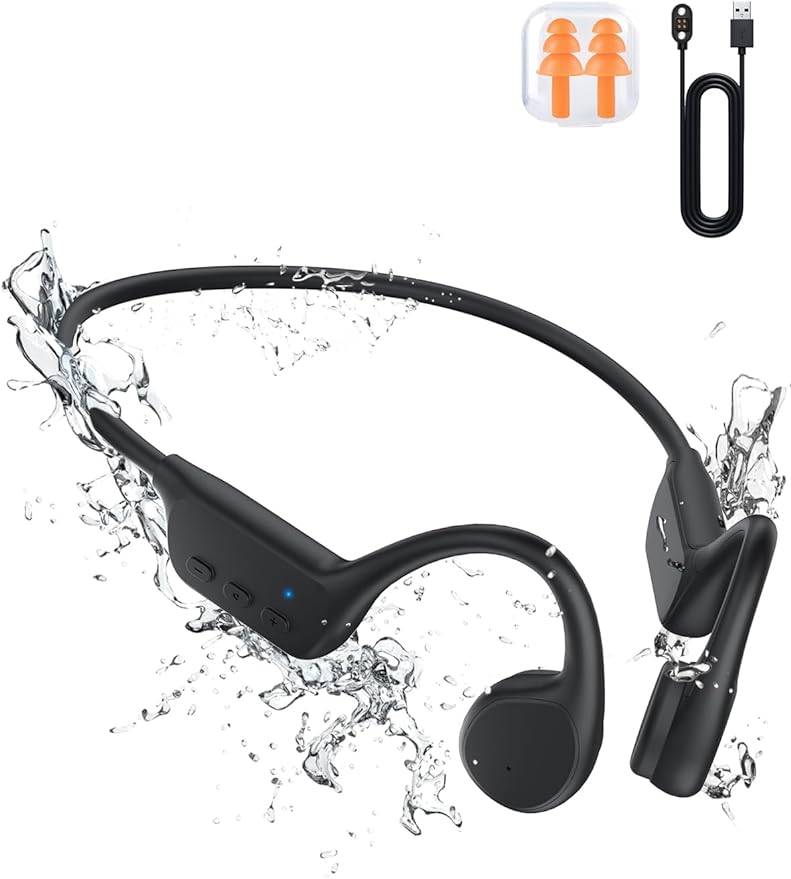
The Rumatas X7 PLUS Bone Conduction Headphones are designed as a truly amphibious device. By integrating IPX8 waterproofing with a standalone MP3 player, they solve the two biggest hurdles of aquatic audio: the failure of Bluetooth and the occlusion of the ear canal. This article explores the electromagnetic absorption of water, the acoustics of underwater bone conduction, and the engineering required to seal a device against the deep.
The Bluetooth Barrier: Why Wireless Fails Underwater
A common frustration for new users of waterproof headphones is the discovery that their Bluetooth connection drops the moment they submerge. This is not a product defect; it is a law of physics.
2.4GHz Resonance and Water Absorption
Bluetooth operates in the 2.4 GHz ISM band. This frequency is chosen for its ability to carry data, but it has a specific weakness: it shares the resonant frequency of the water molecule ($H_2O$). * Microwave Principle: Just as a microwave oven uses 2.45 GHz radiation to heat water in food by causing the molecules to vibrate, a body of water absorbs Bluetooth signals. The signal energy is converted into heat (negligible) rather than propagating to the receiver. * Attenuation: In water, a 2.4 GHz signal is attenuated (weakened) so rapidly that it effectively travels only a few centimeters. The moment your phone is on the pool deck and your head goes underwater, the link is severed.
The Solution: Local Storage (MP3 Mode)
The Rumatas X7 PLUS circumvents this physical barrier by integrating 32GB of Internal Memory. By storing the music files locally on the device (MP3, FLAC, WAV), the need for radio transmission is eliminated.
This transforms the headphones from a receiver into a standalone Digital Audio Player (DAP). It acknowledges that in the aquatic domain, autonomy is the only viable strategy. The 32GB capacity—enough for roughly 8,000 songs—ensures that the swimmer is not tethered to a playlist length shorter than their endurance training.

Underwater Acoustics: Why Bone Conduction Reigns Supreme
Once the music source is secured, how do we hear it? Using traditional in-ear drivers underwater is problematic. Water pressure pushes against the earplug, and the sound becomes muffled as the drivers fight the resistance of the water.
Bone conduction, however, performs better underwater than in air. * Impedance Matching: The human head is mostly water (fluid and tissue). In air, there is an impedance mismatch between the vibrating bone conduction pad and the skull, leading to some energy loss. Underwater, the water surrounding the headphones couples efficiently with the skin and bone. * Conduction Velocity: Sound travels approximately 4.3 times faster in water ($1480 m/s$) than in air ($343 m/s$). The water acts as an extension of the transmission medium. * The Experience: When a swimmer wears the Rumatas X7 PLUS and submerges, the sound often becomes fuller and richer. The water fills the gaps between the transducer and the skin, and the vibration is transmitted efficiently through the cranium. It creates an internal, immersive soundstage that feels like it is originating from inside the head, unaffected by the splashing noise of the stroke.
The Engineering of IPX8: Beyond Splash-Proofing
To operate in this environment, the device must be hermetically sealed. The IPX8 rating of the Rumatas X7 PLUS indicates it can withstand continuous immersion beyond 1 meter.
Sealing and Charging
The weakest point of any waterproof electronic device is the port. A standard USB-C port is a hole that invites water ingress. * Magnetic Charging: The X7 PLUS utilizes a 4-pin Magnetic Charging Interface. This allows the casing to be fully sealed, with no open cavities. The electrical contacts are plated (likely gold or rhodium) to resist corrosion from chlorine or saltwater. * Galvanic Corrosion: Even with plating, electrolysis can occur if a wet device is charged. The design necessitates wiping the contact points dry before charging, a user behavior protocol that is essential for the longevity of amphibious gear.
Material Durability: Titanium and Silicone
Swimming pools are chemical baths (chlorine, bromine), and oceans are salt baths. The materials used must be chemically inert. * Silicone Skin: The entire outer shell is encased in medical-grade silicone. This provides a hydrophobic barrier that repels water and resists chemical degradation. * Titanium Core: The structural integrity comes from a titanium alloy band. Titanium is immune to rust and maintains its spring tension even after thousands of cycles of being stretched over a swim cap.
Conclusion: The Ultimate Multisport Tool
The Rumatas X7 PLUS is a triumph of context-aware engineering. It recognizes that the physics of land and water are fundamentally different.
On land, it uses Bluetooth 5.3 and Open-Ear acoustics to provide safety and connectivity. In water, it switches to Internal Memory and Bone Conduction to overcome signal absorption and impedance issues.
By solving the specific physical constraints of the aquatic environment—not by fighting them, but by adapting to them—it empowers the swimmer to bring the motivation of music into the silence of the deep. It is a device that refuses to be limited by the medium it travels through.