Micro-Acoustics and Algorithmic Clarity: The Physics of Drivers, ENC, and Durability in TWS Earbuds
Update on Jan. 13, 2026, 8:04 a.m.
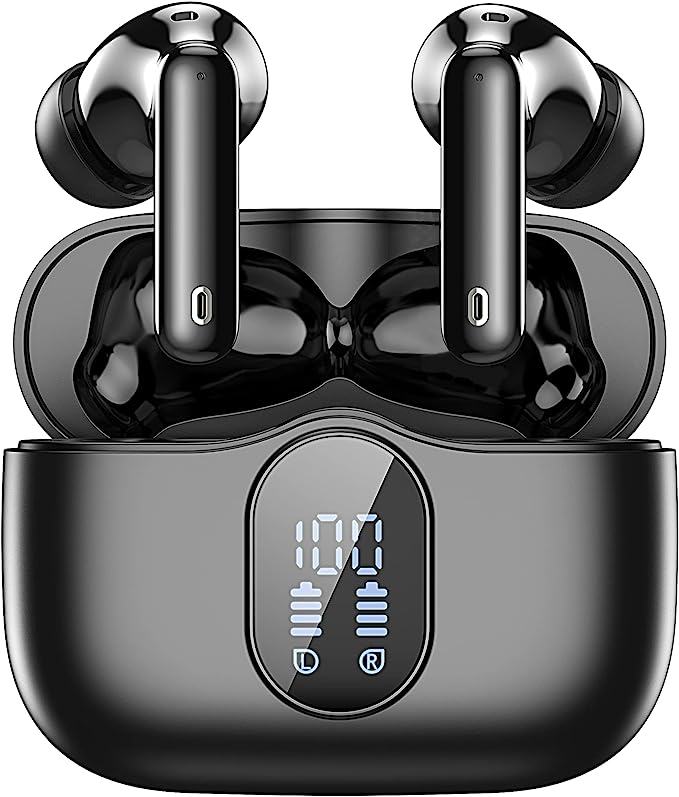
In the microscopic world of True Wireless Stereo (TWS) earbuds, space is the ultimate luxury. Engineers must cram a battery, a radio, an antenna, a computer, microphones, and a speaker into a chassis the size of a marble. The Cillso H97 manages to pack a 13mm driver and a quad-microphone array into this constrained volume. This feat requires a mastery of Micro-Acoustics—the physics of sound in small spaces—and Computational Audio—the use of algorithms to clean and enhance signals.
This article peels back the plastic shell to examine the electromechanical heart of the H97. We will explore how large drivers behave in sealed ear canals, the mathematics behind “Environmental Noise Cancellation” (ENC), and the material science that allows delicate electronics to survive a dunk in water.
The Physics of Sound Generation: The 13mm Dynamic Driver
The spec sheet boasts a 13mm dynamic driver. In the context of in-ear monitors (IEMs), 13mm is considered “large” (typical sizes range from 6mm to 10mm). But what does size actually buy you in terms of physics?
The Displacement Advantage
Sound is simply the compression and rarefaction of air. To produce low frequencies (bass), a driver must move a significant volume of air. * The Formula: Volume Displacement ($V_d$) = Surface Area ($S_d$) $\times$ Excursion ($X_{max}$). * The Physics: A 13mm driver has nearly 70% more surface area than a 10mm driver. This means it can move the same amount of air with less excursion (back-and-forth movement). Less excursion generally means less distortion, as the voice coil stays within the linear region of the magnetic field. * The Result: Effortless bass. The H97 can produce deep, resonant low-end without sounding strained or “boxy,” simply because it has the physical dimensions to push the necessary air mass.
Composite Diaphragms: Taming the Treble
However, large drivers have a downside: they can be heavy and floppy. This leads to “cone breakup” at high frequencies, where the diaphragm wobbles instead of moving as a piston, causing distortion.
To combat this, the H97 uses a “three-layer composite diaphragm.”
* Material Science: By sandwiching a stiff material (like Titanium or PEEK) between softer damping layers (like PU), engineers create a structure that is both rigid and light. The stiffness prevents breakup, ensuring clear highs, while the lightness ensures a fast transient response. This composite approach allows a single driver to cover the full frequency spectrum (20Hz-20kHz) without the need for complex multi-driver crossovers.

The Science of Clarity: ENC and Beamforming Algorithms
One of the most misunderstood acronyms in audio is ENC (Environmental Noise Cancellation). It is frequently confused with ANC (Active Noise Cancellation). * ANC is for you: It uses microphones to cancel noise entering your ear so you can hear music better. * ENC is for them: It uses microphones to cancel noise around you so the person you are calling can hear you better.
The Cillso H97 features 4-Mic ENC. This implies two microphones per earbud. Why two? To perform a mathematical trick called Beamforming.
The Geometry of Sound
- Voice Mic: Located at the bottom of the stem, pointing towards your mouth. It captures your voice + ambient noise.
- Noise Mic: Located on the back or top, pointing away from your mouth. It captures primarily ambient noise.
The Algorithm
The internal DSP (Digital Signal Processor) receives signals from both mics. Because sound travels at a known speed (343 m/s), there is a slight time delay (phase difference) between a sound wave hitting the Noise Mic and the Voice Mic. * Spatial Filtering: The DSP uses this time delay to calculate the direction of the sound. Sounds coming from the direction of your mouth are preserved. Sounds coming from other directions (wind, traffic) are identified as noise. * Spectral Subtraction: The DSP then mathematically subtracts the noise profile captured by the Noise Mic from the signal captured by the Voice Mic. The result is a clean voice signal sent to your phone. This “virtual boom arm” is what allows clear calls even in a breezy environment.
Durability Engineering: The Physics of IP7
The H97 claims an IP7 waterproof rating. This means it can withstand immersion in 1 meter of water for 30 minutes. How do you waterproof a device with holes for microphones and speakers?
The Nano-Coating Shield
While physical seals (O-rings and glues) provide the primary barrier, modern electronics rely heavily on hydrophobic nano-coatings. * Plasma Deposition: During manufacturing, the internal circuit boards are exposed to a plasma that deposits a microscopic layer of polymer. * Contact Angle: This coating lowers the surface energy of the components. When water touches them, instead of spreading out and causing a short circuit, it beads up into a sphere and rolls off. This means that even if a small amount of moisture breaches the outer shell (vapor or sweat), the electronics remain electrically isolated.
Power Management: The Life of a Li-Po Cell
The 40-hour playtime is powered by Lithium-Polymer (Li-Po) cells. Unlike the rigid cylindrical Li-ion batteries (like 18650s) in laptops, Li-Po batteries use a polymer electrolyte and can be packaged in flexible, foil-like pouches. * Space Efficiency: This allows the battery to be shaped to fit the curves of the earbud or the slim profile of the case, maximizing volume utilization. * Cycle Life: Modern Li-Po chemistry is designed to withstand hundreds of partial charge cycles—the typical usage pattern for TWS earbuds (use for an hour, drop in case to top up). The BMS (Battery Management System) on the Bluetooth chip carefully regulates the charging voltage to prevent overheating and prolong cell lifespan.
Conclusion: The Symphony of Integration
The Cillso H97 is a testament to the maturity of the global electronics supply chain. It integrates technologies—composite acoustics, beamforming algorithms, RF engineering, and nano-materials—that were once distinct disciplines.
For the user, this integration is invisible. You simply put them in your ears. But beneath that simple action lies a complex interplay of physics and mathematics, working tirelessly to move air, filter noise, and maintain a connection through the invisible ether. It is a reminder that in the modern world, even the most everyday objects are marvels of engineering.