Dzstorm 2023 Wireless Earbuds Review: Silence, Science, and the ENC Myth


Dzstorm 2023 Wireless Earbuds
The budget audio market is a battlefield of acronyms. Manufacturers plaster terms like "Noise Cancelling," "Hi-Fi," and "Waterproof" onto packaging, often leaving consumers bewildered when the product doesn't silence a jet engine or survive a swim. The Dzstorm 2023 Wireless Earbuds are a prime example of this phenomenon. Retailing at an aggressive entry-level price point, they promise features typically found in premium audio gear: 4-microphone arrays, the latest connectivity standards, and extended battery life.
However, a closer look at user feedback reveals a dichotomy. Some users praise the "crystal clear calls," while others complain that they can "still hear everything" around them. This is not necessarily a product failure, but a misunderstanding of the underlying technology. By dissecting the Dzstorm 2023 wireless earbuds, we aim to clarify exactly what you are buying—and more importantly, what you are not buying—so you can decide if this budget-friendly device aligns with your auditory needs.
The Physics of Communication: Deconstructing 4-Mic ENC
To understand the performance of the Dzstorm, one must first distinguish between two similar-sounding but functionally opposite technologies: ANC (Active Noise Cancellation) and ENC (Environmental Noise Cancellation). * ANC uses microphones to create "anti-noise" to silence the world for you (the listener). * ENC uses microphones to silence the world for the person you are calling.
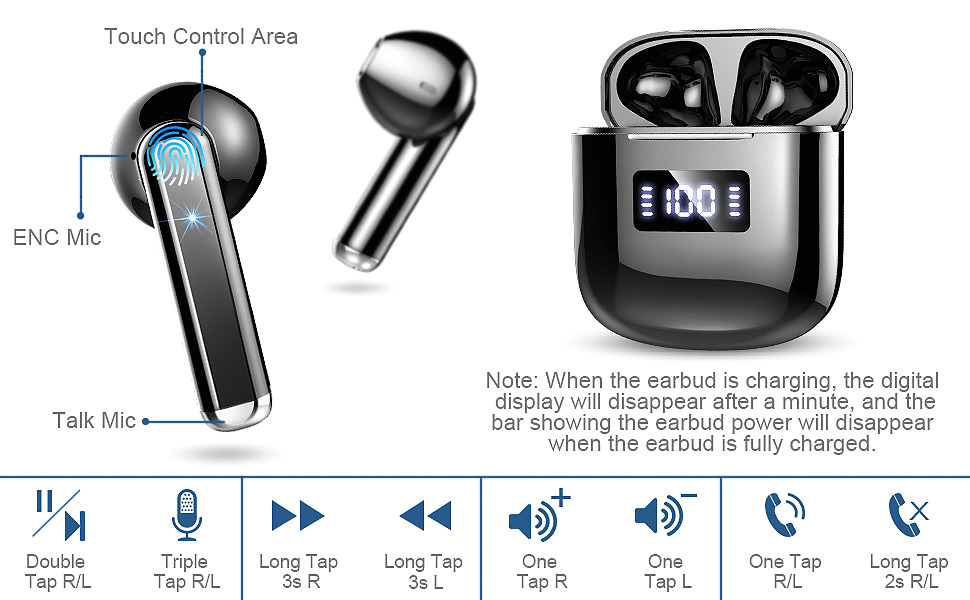
The Dzstorm 2023 utilizes a 4-Mic ENC system. This setup involves two distinct microphones on each earbud. The primary microphone is positioned to capture your voice, while the secondary microphone faces outward to sample the ambient environment. Through a process known as Beamforming, the internal Digital Signal Processor (DSP) analyzes the time delay between sound waves hitting the two mics. It identifies the stationary noise (like wind or traffic) captured by the secondary mic and mathematically subtracts it from the signal sent to your caller. This ensures that while you might hear the chaotic street noise around you, your voice transmits clearly. This specific implementation is the defining feature of the 4 mic call noise cancelling technology found in the Dzstorm.
The Connectivity Leap: Bluetooth 5.3 Protocol
Wireless audio has historically been plagued by two demons: Latency (the delay between video and audio) and Stability (dropouts in crowded areas). The Dzstorm 2023 leaps ahead of many budget competitors by adopting the Bluetooth 5.3 standard.
Unlike the older Bluetooth 5.0 found in bargain-bin alternatives, version 5.3 introduces improved "Connection Subrating." This feature allows the device to switch between high-duty cycles (active listening) and low-duty cycles (standby) much faster and with less power overhead.
1. Signal Robustness: In environments saturated with 2.4GHz interference (like a gym or subway), the 5.3 protocol maintains a tighter handshake with the host device, reducing the "skipping" effect.
2. Efficiency: This efficiency contributes directly to the claimed 25-hour total playtime. The chipset draws less power to maintain the connection, allowing the small batteries to last longer.
3. Latency: While not a dedicated "gaming mode," the inherent efficiency of 5.3 reduces the audio lag, making these wireless earbuds Bluetooth 5.3 compliant devices suitable for watching videos without the jarring lip-sync error.
The "Quiet Earbud" Phenomenon: A Biological Failure
A recurring theme in negative reviews for the Dzstorm—and indeed, most in-ear monitors—is the complaint that "one side became quiet" after a few months. Users often assume the speaker driver has blown or the battery has failed. However, the cause is almost always biological, not electrical.
The ear canal produces cerumen (earwax), a sticky, hydrophobic substance. When you wear earbuds, especially during exercise, body heat liquefies this wax. It flows into the microscopic mesh intended to protect the driver. When you remove the buds, the wax cools and solidifies, forming an acoustic cement that physically blocks sound waves. Because the Dzstorm 2023 wireless earbuds are marketed as waterproof sport headphones, users are more likely to sweat in them, exacerbating this issue. The driver is still pumping sound at full volume, but it is trapped behind a wall of debris. This is a maintenance issue, not a manufacturing defect, and is the primary reason why perfectly functional earbuds are discarded.
Dzstorm 2023 Wireless Earbuds
Related Essays

