Sajawass BX30 : Do These 80-Hour Sport Earbuds Defy Gravity?


Sajawass BX30 Wireless Earbuds
In the realm of consumer electronics, specifications often write checks that physics cannot cash. We are told that "invisible" in-ear beans will stay put during a marathon, only to find ourselves constantly adjusting them as sweat breaks the friction seal. The Sajawass BX30 represents a rejection of this minimalist aesthetic in favor of brutalist utility. It is not trying to be invisible; it is trying to be immovable.
With a prominent over-ear hook design and a claimed 80 hours of total battery life, the BX30 is clearly engineered for the ultra-marathoner, the heavy lifter, and the commuter who forgets to charge their devices. But adding physical bulk to the human ear introduces a complex interplay of leverage and biological compatibility. Does the Sajawass BX30 successfully navigate the trade-off between stability and comfort, or does it simply trade one form of ear fatigue for another? This analysis moves beyond the spec sheet to examine the mechanical and electrical realities of these wireless sport earbuds.
The Biomechanics of Suspension: Defeating Gravity
To understand why the BX30 looks the way it does, we must understand the failure mode of standard earbuds: Gravity vs. Friction. Standard earbuds rely on the friction between the silicone tip and your ear canal to counteract the downward pull of gravity. As you run, impact forces multiply the effective weight of the bud (G-force). Simultaneously, sweat acts as a lubricant, reducing friction. Inevitably, the bud slips.
The Sajawass BX30 solves this through Mechanical Suspension. The flexible earhook transfers the load from the sensitive ear canal to the "root of the helix"—the cartilaginous ridge where your ear meets your skull. This is a structural anchor point capable of supporting significantly more weight than the ear canal. * The Benefit: The ear tip no longer needs to be jammed in tightly to hold the device up; it only needs to seal for audio. This "floating fit" reduces the sensation of pressure (occlusion effect) during long listening sessions. * The Trade-off: The hook occupies the same physical space as the temples of your glasses. While the silicone is soft, the overlapping vectors of pressure can cause soreness behind the ear after 45 minutes of concurrent use.
Despite this conflict with eyewear, for the unbespectacled runner, this suspension architecture is the only reliable way to ensure waterproof headphones running scenarios don't end with an earbud in a puddle.

The Capacitive Paradox: Touch Controls in a Wet World
Modern aesthetics demand sleek, button-free surfaces. The BX30 complies with this trend by utilizing Capacitive Touch Sensors. These sensors work by detecting the change in electrical capacitance when a conductive object (your finger) bridges the sensor's field.
However, in a sports context, this presents a physics problem: Dielectric Interference.
1. The Science: Human sweat is a conductive electrolyte solution. To a capacitive sensor, a bead of sweat looks remarkably like a fingertip.
2. The Failure Mode: When you are mid-sprint and dripping with sweat, the sensor may register "phantom touches" (pausing your music arbitrarily) or, conversely, fail to register your actual finger because the water layer masks the capacitance change.
While the Sajawass BX30 tune is relatively robust, users should be aware that this is an inherent limitation of the technology. Mechanical buttons are ugly, but they work when wet. Capacitive touch is sleek, but it struggles against the very fluids generated by the activity these wireless sport earbuds are designed for.
The Density Equation: Deconstructing the 80-Hour Claim
One of the most eye-catching numbers on the BX30's spec sheet is the 80 hours of total playback time. In an industry where 24 hours is standard, this seems like an anomaly. How is this achieved?
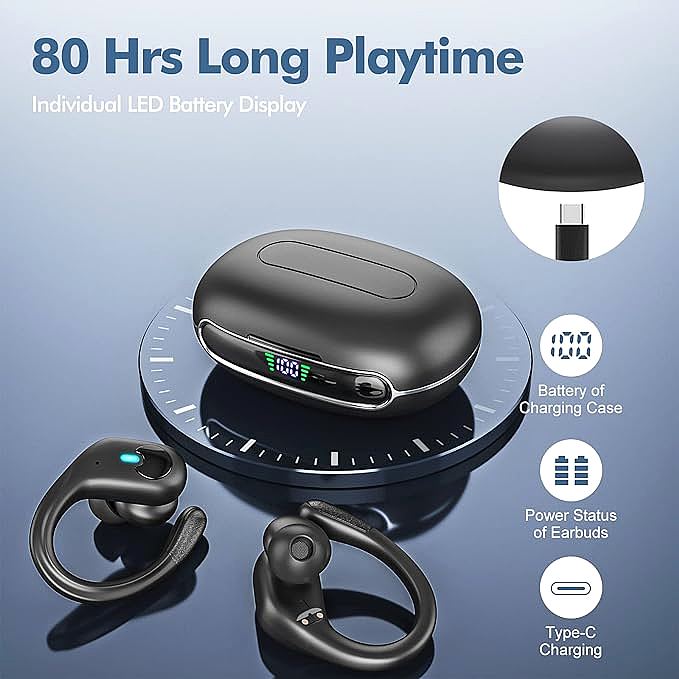
The answer lies in Volumetric Energy Density. Because the Sajawass BX30 utilizes an over-ear design, the earbuds themselves are larger, accommodating slightly larger cells (likely 50-60mAh). However, the real power plant is the charging case. * The Case: The carrying case is significantly bulkier than an AirPod case. This extra volume allows Sajawass to pack a massive 650mAh (estimated) lithium-ion battery inside. * The Logic: It is a brute-force engineering solution. Rather than using expensive, high-density proprietary cells, they simply increased the physical size of the fuel tank.
For the user, this means the case is not "pocketable" in skinny jeans, but it turns the device into a localized power grid. You can go weeks without plugging the case into a wall. The inclusion of a Dual LED Digital Display on the front is a crucial piece of UI that demystifies this power reserve, giving you an exact percentage readout—a feature sorely missing from premium competitors that cost five times as much. This transparency transforms the 80 hours playback claim from a marketing abstraction into a manageable resource.