The Metallurgy of Torque: Anodized Aluminum vs. Graphite in Saltwater Kinetics - Case Study: Daiwa BG8000


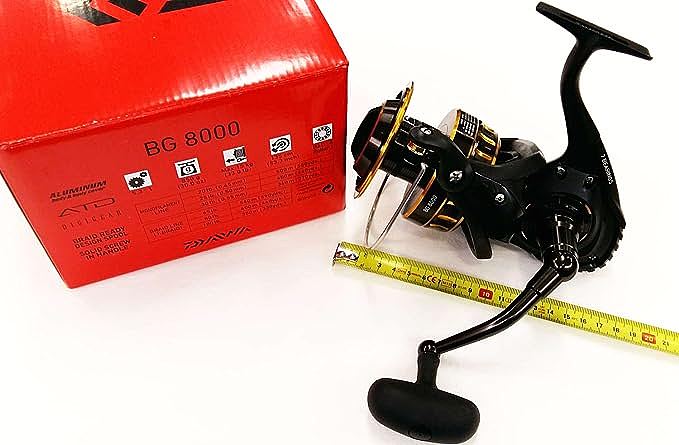
Daiwa BG8000 BG Saltwater Spinning Reel
In the discipline of heavy saltwater angling, "Torque" is often misunderstood. It is not merely the force required to turn a handle; it is a war against structural deformation. When an angler battles a 50-pound Amberjack or launches an 8-ounce sinker into the surf, the fishing reel acts as a transmission system under immense stress.
The market trend has drifted toward "lightweight" composites—carbon-infused plastics that look sleek and feel weightless in the tackle shop. However, physics dictates a cruel trade-off. As material density decreases, susceptibility to flex often increases. In the high-stakes environment of surf fishing, a flexible frame is a catastrophic failure point. It leads to gear grinding, energy loss, and mechanical seizure. To understand why heavy metal is making a resurgence in technical circles, we must examine the metallurgy of torque, the geometry of gear contact, and the specific engineering choices found in the Daiwa BG8000 BG Saltwater Spinning Reel.
The Modulus of Elasticity: Why Frames Flex
The primary enemy of a spinning reel is not the fish; it is Frame Flex.
Every material has a Young's Modulus (Elastic Modulus), which measures its stiffness.
* Graphite/Nylon Composites: Typically have a modulus between 3 and 15 GPa. Under heavy drag pressure (e.g., 30 lbs), the "stem" of the reel (the part connecting the body to the rod) acts like a stiff spring. It bends.
* Aluminum Alloys: Typically have a modulus around 69 GPa. They are inherently rigid.
The Consequence of Flex:
Inside the reel, the main drive gear and the pinion gear must mesh with micrometer precision. When a composite frame flexes under load, the axis of the drive gear shifts. The teeth no longer mesh perfectly flat; they mesh at an angle. This point-loading concentrates force on the tips of the gear teeth, leading to rapid wear (pitting) and that characteristic "grinding" feel after a few heavy fights.
Case Study Application:
The Daiwa BG8000 utilizes what the brand terms a "HardBodyz" housing. Marketing jargon aside, this is a Machined Aluminum chassis.
By using a metal with high rigidity, the BG8000 maintains the axial alignment of its gears even when the drag is locked down to its 33lb (15kg) maximum. The frame acts as an unyielding exoskeleton, ensuring that user effort is converted into line retrieval rather than wasted on deforming the plastic body. This is why seasoned anglers describe the reel as feeling "tank-like"—it is the tactile sensation of structural rigidity.
Hertzian Contact Stress: The Geometry of Gearing
Once the frame is secured, the load transfers to the gears. Here, the governing principle is Hertzian Contact Stress—the pressure created where two curved surfaces (gear teeth) meet.
To reduce this stress and extend the life of the metal, engineers have two options:
1. Use harder, more expensive materials (Stainless Steel).
2. Increase the physical size of the gears (Geometry).
In the sub-$150 price category, using aerospace-grade steel gears is cost-prohibitive. Therefore, the engineering solution must be geometric.
The Daiwa BG8000 employs an "Oversized Digigear" system.
* The Math: By increasing the diameter of the drive gear (reportedly 20-40% larger than standard reels in this class), the contact patch between the drive gear and pinion gear increases.
* The Benefit: Force is distributed over a larger surface area. This lowers the pressure (PSI) on any single point of the tooth face. This geometric advantage allows the reel to generate immense cranking torque without stripping teeth, mimicking the performance of much more expensive reels that rely on exotic alloys.
The Anodization Barrier: Combating Entropy
Saltwater is an electrolyte. When aluminum touches stainless steel (bearings) in the presence of saltwater, Galvanic Corrosion begins. The aluminum acts as an anode and sacrifices itself, turning into white powder.
To prevent this, the aluminum surface must be passivated. The BG8000 features a Black Anodized finish. Unlike paint, which sits on top, anodization converts the surface aluminum into Aluminum Oxide (Al2O3)—a ceramic that is extremely hard and electrically insulating. This layer prevents the electrolyte (seawater) from completing the circuit between the aluminum body and the steel internals, fundamentally extending the reel's lifespan in corrosive environments.
