The Hydrodynamics of Biofilm Disruption: 1800 PPM Mechanics - Case Study: Nicwell W01
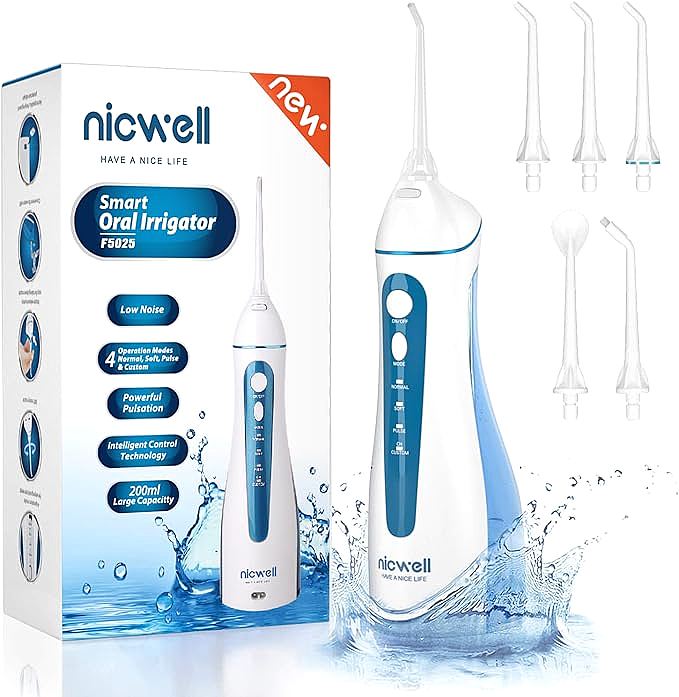
Nicwell W01 Water Dental Flosser
The human mouth is a landscape of complex topography, but traditional hygiene treats it like a flat surface. We scrub back and forth with nylon bristles, assuming friction alone is sufficient to maintain health. This geometric oversimplification leaves approximately 40% of the tooth surface—specifically the interproximal zones and the gingival sulcus—untouched. In these "Protected Sanctuaries," bacteria organize into a sophisticated structure known as Biofilm.
Biofilm is not merely "food debris"; it is a sticky, viscoelastic polymer matrix that adheres tenaciously to enamel. Standard rinsing or low-pressure flushing flows over this matrix like water over a river rock. To breach this defense, one needs a force that exceeds the yield stress of the bacterial adhesion without damaging the delicate epithelial tissue of the gums. This requires Hydrodynamic Shear Force. The Nicwell W01 Water Dental Flosser claims to deliver this force through a specific engine calibration: 1,800 pulses per minute. This article dissects the physics of pulsation and why frequency is just as critical as pressure in the war against periodontal disease.
The Physics of Pulsation: The "Micro-Hydraulic Hammer"
Many consumers equate "cleaning power" solely with PSI (Pounds per Square Inch). However, in fluid dynamics, continuous pressure (Laminar Flow) is often less effective at dislodging sticky substances than fluctuating pressure (Pulsatile Flow).
The Nicwell W01 operates between 1400 and 1800 pulses per minute. This frequency creates a phenomenon known as Micro-Hydraulic Hammering.
- Compression Phase: A packet of water impacts the biofilm surface, compressing the polymer matrix and creating potential energy.
- Decompression Phase: The brief interval between pulses (milliseconds) allows the tissue to recoil and the water to expand.
- Fatigue Fracture: This rapid cycle of compression and decompression induces structural fatigue in the biofilm. Much like a jackhammer breaks concrete not by static weight but by repeated impact, the pulsating water stream fractures the bacterial colony's structural integrity.
Clinical studies suggest that this pulsatile action is significantly more effective at reducing gingival inflammation than continuous stream devices because it also stimulates blood flow in the capillary beds of the gum tissue—a process akin to a high-frequency massage.
The Nicwell Solution: Calibrating the Engine
The engineering challenge in portable oral irrigators is balancing Motor Torque with Battery Efficiency.
The Nicwell W01 utilizes a high-torque DC motor powered by a lithium-ion battery to drive a piston pump.
* Frequency Modulation: At the "Clean" setting, the device hits the 1800 PPM ceiling. This frequency is tuned to maximize the "Shear Stress" applied to the tooth surface. Shear stress is the tangential force of the moving fluid.
* Pressure Range: The 30-110 PSI range allows the user to modulate the intensity of this hammer.
* 30 PSI: Generates enough shear to flush planktonic (free-floating) bacteria and food debris without detaching the epithelial attachment of the gum.
* 110 PSI: Generates the kinetic energy required to strip away the "Calculus Bridge"—the hardened precursor to tartar—before it mineralizes fully.
By adhering to this specific Pulse-Pressure ratio, the device effectively functions as a non-invasive hydrodynamic drill, accessing the anatomical blind spots that are the breeding grounds for periodontal pathogens.
Nicwell W01 Water Dental Flosser
Related Essays
Nicwell W01 Review: Does This $30 Flosser Beat the $80 Giants?
Silence and Science: Analyzing the Ergonomics of the Waterpik WF-13 Cordless Pearl