Overcoming the Tilt Vector: The Physics of Omnidirectional Hydraulics in Handheld Irrigators - Case Study: H2ofloss HF-6
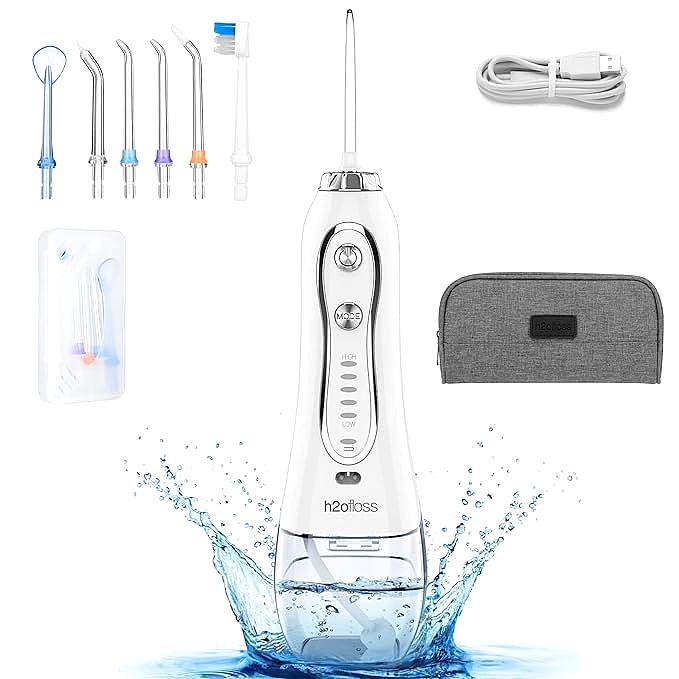
H2ofloss HF-6 Water Flosser
There is a specific, irritating sound known to every user of a standard portable water flosser: the hollow, high-pitched whine of a pump sucking air. It usually happens at the worst possible moment—precisely when you tilt the device to clean the lingual (tongue-side) surface of your upper molars. As the water level in the reservoir shifts away from the rigid intake straw, the hydraulic seal breaks, the pressure drops to zero, and the cleaning session is interrupted.
This is not just a nuisance; it is a fundamental flaw in the geometry of early handheld irrigators. The mouth is a three-dimensional cavity requiring 360 degrees of access, yet most devices are engineered to work only when held vertically. This misalignment between User Anatomy and Device Physics leads to "Air Lock" (cavitation), which can damage the pump mechanism over time. The H2ofloss HF-6 Water Flosser addresses this specific hydraulic failure with a solution that is remarkably low-tech yet functionally brilliant: The Gravity Ball. This article deconstructs the mechanics of omnidirectional intake systems and why "Orientation Independence" is the most underrated spec in oral care.
The Context: The Geometry of Suction vs. Gravity
To understand why the "Tilt Problem" exists, we must look at the interaction between gravity and the intake manifold.
In a traditional design, a rigid plastic tube extends from the pump to the bottom of the tank. This works perfectly—as long as the device is upright and the water covers the tube opening.
However, to reach the Lingual Aspect of the maxillary teeth (the back of the upper teeth), a user typically leans over the sink and inverts the flosser handle.
* The Failure Mode: In this inverted position, gravity pulls the water to the "top" of the tank (now the bottom, relative to the ground). The rigid tube, however, remains pointing at the "bottom" (now the top), suspended in empty air.
* Cavitation: The pump draws in air instead of water. Since water pumps are designed for incompressible fluids, the introduction of compressible air causes the impeller or piston to race, creating heat and wear, and completely halting the cleaning jet.
The Core Mechanism: Vector Alignment via Weighted Intake
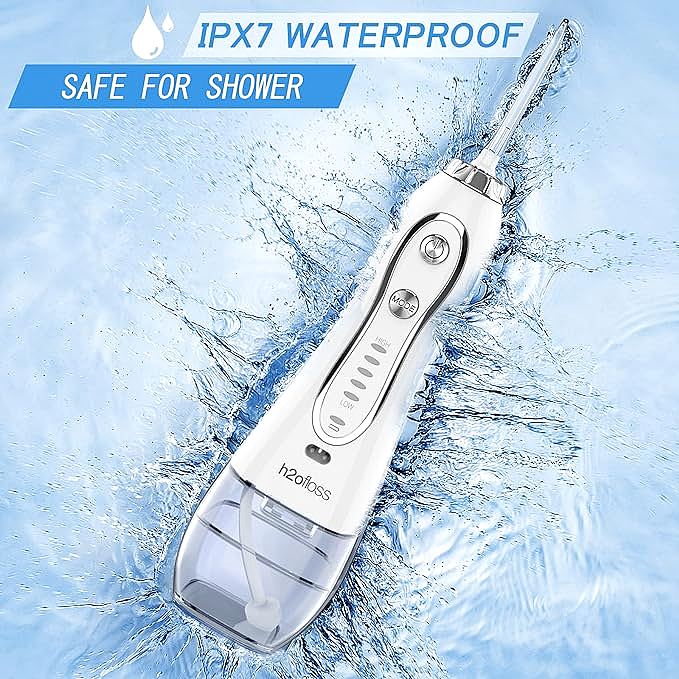
The H2ofloss HF-6 solves this by decoupling the intake from the device's chassis. Instead of a rigid straw, it employs a Flexible Silicone Manifold tipped with a Weighted "Gravity Ball."
This system relies on a simple principle of physics: Vector Alignment.
1. Shared Force: Gravity acts equally on the liquid in the reservoir and the weighted ball.
2. Synchronized Movement: When you tilt the device, the water flows to the lowest point in the container. Simultaneously, the weighted ball swings on its flexible tether to that exact same lowest point.
3. Result: The intake port (housed inside the ball cage) is perpetually submerged, regardless of the device's orientation.
This allows for Omnidirectional Functionality. You can hold the HF-6 sideways, upside down, or at any ergonomic angle required to flush out a periodontal pocket, without ever breaking the hydraulic seal. It transforms the device from a "static upright tool" into a "dynamic handheld instrument."
Product Validation: The Pressure Gradient
While the Gravity Ball ensures continuity of flow, the 5-Mode Pressure System ensures the quality of that flow.
Many budget flossers offer a binary choice: High (for blasting) or Low (for... less blasting). The HF-6 offers a granular spectrum from 20 PSI to 110 PSI.
This range is biologically significant:
* The Low End (20-40 PSI): This is critical for Soft Tissue Safety. Users cleaning Tonsil Stones (tonsilloliths) or extremely inflamed gingiva need a stream that flushes without piercing. 20 PSI provides this gentle irrigation.
* The High End (110 PSI): To remove mature biofilm (plaque) from the enamel surface, sheer force is required. 110 PSI generates the impact velocity needed to dislodge sticky food debris and disrupt bacterial colonies deep between tight contacts.
By combining an intake system that works at any angle with a pressure system that adapts to any tissue sensitivity, the HF-6 validates itself not just as a gadget, but as a comprehensive hygiene tool.